Josh Cameron: Lumix S9 Lover’s Take On The Sigma BF

Josh Cameron dives into a unique comparison between the Sigma BF and the Lumix S9, reflecting on design, usability, and purpose. He praises Sigma’s history of creating unconventional, artistic cameras—from the DP Quattros to the FP series—and now the BF, which he describes as “beautifully foolish.”

The Sigma BF is a minimalistic full-frame camera made from a solid block of aluminum, with a 24MP sensor, 230GB of internal memory, no SD slot, and just a single USB-C port. There’s no EVF, no hot shoe, no Wi-Fi or Bluetooth, and a fixed screen. Despite all this, Josh compares it to a luxury watch—beautiful, well-crafted, and intended for those who value form over function.

In contrast, the Lumix S9 is called his favorite camera ever. It’s affordable, has a fully articulating touchscreen, mic input, micro HDMI, cold shoe, Wi-Fi, Bluetooth, SD card slot, IBIS, and stunning out-of-camera JPEGs. The S9 is considered the better tool, while the BF is the elegant statement piece.

Josh admits the Sigma BF has many limitations, including the lack of touch functionality except for AF point selection, no stabilization, and quirky color science in some picture profiles. Still, he deeply appreciates the experience, the tactile feel, and the originality of the BF. He encourages viewers to see it as a collector’s piece—something special in a sea of lookalike cameras.

His final verdict? The Lumix S9 is the best EDC camera. The Sigma BF is a love letter to design nerds and camera enthusiasts who want something different, even if it means sacrificing practicality.
New Sigma 200mm reviews

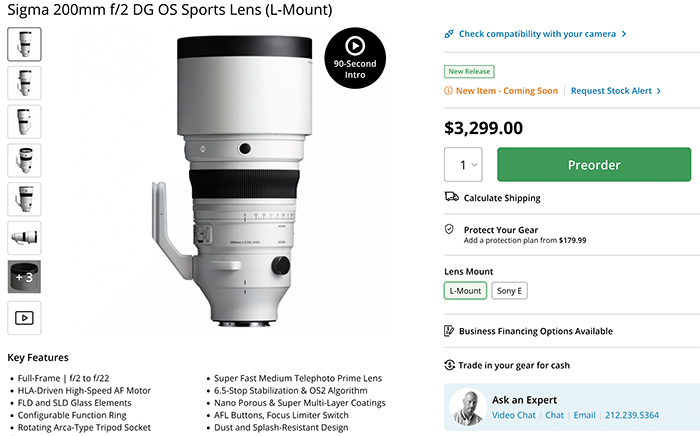
Preorders: Sigma 200mm f/2.0 at BHphoto, Amazon, Adorama, FotoKoch, FotoErhardt, Calumet, WexUK.

PCmag tested the lens and concluded:

The Sigma 200mm F2 DG OS Sports is a stunner, both in terms of the images it captures and the speed and accuracy with which it focuses. And while it’s more expensive than pro zooms at $3,299, it leaves nothing to be desired. Photographers who cover indoor sports in venues with so-so illumination will appreciate its aperture, and the lens is just as good a tool for portraiture and other scenes that isolate a subject from its surroundings. It’s a shame that the lens doesn’t support rear teleconverters, but we have no real gripes otherwise, so the 200mm F2 DG OS Sports earns our Editors’ Choice award.

More Youtube reviews:

Leica Vario-Elmar-SL 100-400mm f/5-6.3 lens review by Cristopher Frost

His conclusion:

  • Build & usability:
    • Excellent, tough metal construction, weather-sealed, and a pleasure to handle despite being large (1.12 kg).
    • Smooth zoom and focus rings, though manual focus response feels inconsistent.
    • Image stabilization is effective.
  • Optical performance:
    • Sharpness in the center is excellent at shorter focal lengths, but weaker contrast and corner sharpness at 400mm.
    • Stopping down to f/8 improves sharpness and contrast slightly.
    • With the optional 1.4x teleconverter, sharpness and contrast degrade further, and some optical decentering was noted.
    • Vignetting and distortion are well-controlled, but pincushion distortion increases at 400mm.
    • Bokeh is pleasing and smooth, with no chromatic aberration detected.
  • Other observations:
    • Autofocus is fast, quiet, and reliable.
    • Flare is moderate at wide angles and improves when zoomed.
    • Close focusing (1.1m) offers good magnification and sharpness.
  • Value:
    • At ~£2,000–2,300, it’s more affordable than most Leica lenses but still pricey.
    • Best suited for 24MP cameras; likely struggles to resolve well on higher-resolution sensors.
  • Verdict:
    • Great for wildlife and telephoto work with excellent build and nice bokeh.
    • Not quite sharp enough at long end and on high-res cameras to fully justify the price.

Leica Vario-Elmar SL 100–400mm f/5–6.3 at B&H Photo, Amazon, Adorama.

The impossible comparison: New $5100 Sony RX1rIII vs the $2700 Sigma BF+lens size comparison

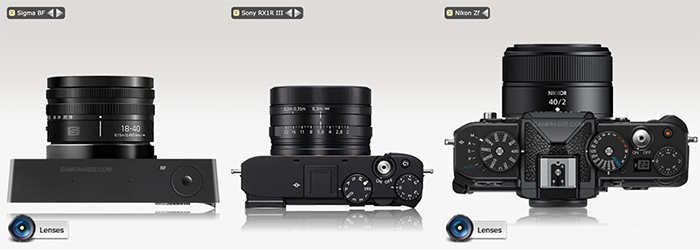
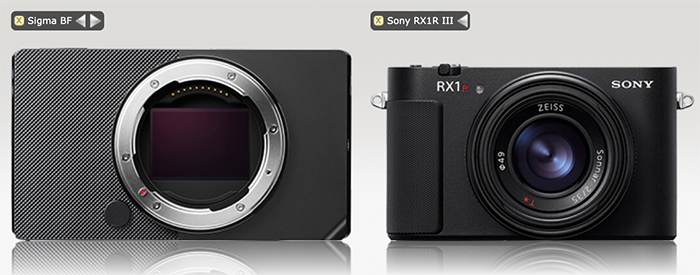
Sony recently unveiled the new RX1rIII, currently the most compact full-frame camera with a fixed lens on the market. And because of its price tag of $5,100, it’s causing quite a stir on the internet. Before you yell at me: I am aware that this is like comparing apples and oranges. But I found one aspect interesting: the Sony RX1rIII is not that much smaller than the Sigma BF with a Panasonic 18-40mm lens:

Yes, I know, folks, Sony has a built-in EVF (even if it only has 2.36 million pixels), which would be very handy on the Sigma BF. But both cameras have things in common, such as the lack of IBIS and no tiltable screen. And yes, in this picture, the Sigma is using the $500 Panasonic 18-40mm lens, but maybe one day Sigma could release a lens like the Nikon 40mm f/2.0, which is basically the same size as the Lumix zoom lens:

What I’m trying to say is that the BF could come very close to the Sony RX1rIII, which costs twice as much, with a beautiful f/2.0 pancake lens. In the future, a Sigma BF2 could even be equipped with an integrated EVF, which would certainly make us photographers very happy!

Image via CameraSize


Terry Warfield explains why he is leaving Sony for Panasonic

Terry Warfield made this video to explain why he sold the Sony ZV-E1 for the new Panasonic Lumix S1 Mark II.

Why he loved the ZV-1

  • Ultra-compact full-frame video camera (same 12 MP sensor as FX3/FX6/A7S III)
  • Excellent low-light performance (dual base ISO), fast read-out (minimal rolling shutter)
  • Uncropped 4K 60 fps and 4K 120 fps (10 % crop), built-in ND filter, stellar autofocus, in-body stabilization
  • Great “vlog” features (flip-out mic, picture profiles) and 12 MP stills for social media

ZV-1 drawbacks

  • Overheats in long-form or warm-weather shooting (small body, no active cooling)
  • Tiny micro-HDMI port limits external-monitor hookups; no built-in waveforms/vector scopes/anamorphic support
  • Rear LCD is low-quality
  • Only 12 MP photos—limits cropping or high-res still work

Why the Lumix S1 Mark II

  • Full-frame hybrid powerhouse: 24 MP (doubles resolution), up to 6K 60 fps “open­gate,” 4K 120 fps with minimal crop
  • Partially-stacked sensor yields nearly the same fast read-out (rolling shutter) as the ZV-1
  • Superb low-light/dynamic-range at ISO 6 400 and above—competes with the ZV-1’s dual-base ISO
  • Full-size HDMI, built-in cooling fan, USB streaming, real-time LUTs (built-in scopes, markers, anamorphic modes)
  • Solid stills (70 fps burst) plus video assist tools—no need for external monitor 99 % of the time

Trade-off

  • S1 II is ~$3 200 vs. ZV-1 at ~$2 200—different price brackets
  • S1 II body is larger and heavier, but still reasonably compact for a full-frame cine-hybrid
  • Sony’s lens ecosystem remains stronger (photo and cinema glass), but Panasonic covers almost every need in-camera

Bottom line: Ty’s ZV-1 remains a stellar compact video camera, but the Panasonic S1 Mark II better addresses his needs for extended recording, advanced monitoring, higher-res stills, and pro-level codecs—making it his new go-to rig.

Preorders:
Lumix S1II at Bhphoto, Amazon, Adorama, Fotokoch, FotoErhardt, WexUK.
Lumix S1IIE at Bhphoto, Amazon, Adorama, Fotokoch, FotoErhardt, WexUK.
24-60mm f/2.8 at Bhphoto, Amazon, Adorama, Fotokoch, FotoErhardt, WexUK.